Welcome To The New Technorati
Shared via AddThis
Thursday, October 15, 2009

Monday, October 12, 2009
the mean machines
The mean machines are back in town and how! With the launch of the Kawasaki Ninja 250R, Bajaj has turned on the heat on the other auto manufacturers to burn some serious rubber. Here we feature some of the well-known mean machines that get many a heart racing!!

Karizma ZMR
Hero Honda Motors started it all with the ZMR. In September 2009, it launched a newer version of the Karizma ZMR at an introductory price of Rs 91,000 (ex-showroom) in New Delhi.
The engine featured a mild power upgrade and fuel injection technology instead of the older carburetor. Taking a cue from its competitors, the new four-stroke bike was fitted with an oil cooler. The revamped bike had redesigned rear quarter panels and a new LED taillamp. The 223cc bike can hit 60 kmph in 3.7 seconds and can hit a maximum speed of 126kmph.
The world's largest two-wheeler manufacturer posted its highest quarterly gain ever in the first quarter ended July 2009. The company posted a profit-after-tax of Rs 500.11 crore, riding on record million unit sales in the first quarter of the financial year 2009-10. It was the first time that the company had crossed the million-unit mark.

Suzuki Hayabusa
A hyper sport bike introduced by Suzuki, the Hayabusa was continuously the fastest motorcycle in the world before the Japanese voluntarily decided to put brakes on the speed.
Hayabusa derives its name from the Japanese term for Peregrine Falcon. The bird can clock speeds of more than 320km/h. When it was introduced in 1999, it overtook the Honda Super Blackbird as the fastest production motorcycle.
The first generation of the Hayabusa was called the GSX1300R and was powered by a 1,299 cc (79.3 cu in) inline-4 liquid-cooled engine. It remained substantially unchanged up through the 2007 model year.
The Hayabusa's roaring success prompted other motorcycle manufacturers to come up with similar speed merchants like the BMW K1200S and the Kawasaki ZX-14R. The Hayabusa's 4-stroke, four-cylinder liquid-cooled 1299cc engine enables it to generate an enormous peak power of 175 bhp at 9800 rpm and reach from 0-100 km/h in three seconds flat!

Yamaha YZF R1
The Yamaha YZF-R1 bike, launched in 1998, revolutionized the sportbike landscape by successfully combining the awesome power available previously in the 1,000cc class with the lightweight and responsive 600-class chassis. It is the only production motorcycle with crossplane crankshaft engine.
Over the years, despite maintaining its distinctive sharp look, the R1 has undergone technical upgradations to keep pace with the times. The 2009 R1 has much of the Valentino Rossi's World Championship technology. It had undergone a complete makeover with a new front and rear suspension. The exhaust system is meticulously designed to enhance engine output while, thanks to its three-way catalyst technology, also reducing exhaust emissions.
Improved traction management isn't the only upside to the crossplane design. Reduced crank shake and a counter-rotating balance shaft gives you the smoothest ride. The bike won Motorcyclist Magazine's Motorcycle of the year Award.
In 2010, the company plans to launch a limited edition of the YZF-R1 LE Valentino Rossi / Fiat Yamaha replica complete with the number "46" and "The Doctor" logos, including a replica of Valentino Rossi's signature on the fuel tank.

Honda CBR1100XX Blackbird
The CBR1100XX was the culmination of Honda's ambitious effort to produce the ultimate superbike. The CBR's liquid-cooled, 16-valve DOHC inline-four cylinder 1137cc engine generates a peak power of 153 bhp at 10000 rpm.
On the braking front, Honda's revolutionary Linked Braking System (LBS), first used in the 1993 CBR1000F and completely revised on the 1996 ST1100, simultaneously engages both front and rear brakes when either the front brake lever or rear brake pedal is used.
The CBR's dual-spar diamond-configuration aluminum frame features a triple-box-section extruded aluminum swingarm that offers exceptional rigidity without excessive size and weight. The swingarm is supported by a standard Honda Pro-Link rear suspension system which features an H.M.A.S. rear damper.
Source: India Syndicate, company websites
Hero Honda New Karizma ZMR Price, Specifications, Vehicle Summary

| |||||||||||||||||||||||||||||||||||||||||||||||||||||||||||||||||||||||||||||||||||||||||||||||||||||||||||||||||||||||||||||||||||||||||||


Design & Style


Instrument Cluster

Shades Available


Overview - Finally Karizma Gets Fuel Injection Technology
Karizma ZMR has been making a lot of news in automotive market since some photos of Karizma in white shade leaked on net. Now Hero Honda has finally launched the much awaited tourer bike - Karizma ZMR Fi in Indian Market. Karizma ZMR will be sold along with old Karizma model, Hero Honda has decided not to phase out Karizma R and sell both the models side by side. They don't want to end the competition for Apache & Pulsar as Karizma R is priced around 72000.00.
The stance remains the same as the old Karizma which is still considered to be the best touring bike in India with smooth, refined and relaxed Honda engine at the helm. The major and much needed change is addition of programmed fuel injection (PGM-Fi) in the engine. Additionally it also gets disc brake at the rear, gas charged rear shock absorbers, little increase in power and torque. Hero Honda has also started giving teaser advertisement on leading TV channels in which they show few glimpses of New ZMR's front fairing, headlight and tail light.
Design & Style Of Hero Honda Karizma ZMR
In terms of looks the most visible change is heavy looking full front fairing with a lot of snazzy graphics with 'ZMR' stickers. Though it seems a liitle bit overworked and give Karizma ZMR a plasticky look. The designers at Hero Honda 'R&D' must have been a fan of Suzuki Hayabusa!! As far as new features are concerned the New Karizma ZMR gets all new headlamps with integrated blinkers and new tail lamps which are now LED ones.
The fit and finish is quite good, there are no panel gaps and paint quality is awesome. The rear view mirrors have been mounted on the front fairing a.k.a Yamaha R15, which is the best part of the facelift and it gives Karizma ZMR a very aggressive look if viewed from front. But the main problem is if you view the bike from side - the front doesn't gel with the slim looking rear. Hero Honda should have made the rear end a bit heavy to match it with the heavy front fairing. All in all, New Karizma ZMR looks much better than the outgoing model which started looking very outdated in comparison to the Yamaha R15, Bajaj Pulsar 220, TVS Apache RTR 180 & Honda CBF Stunner Fi.
Instrument Cluster & Features Of Hero Honda Karizma ZMR
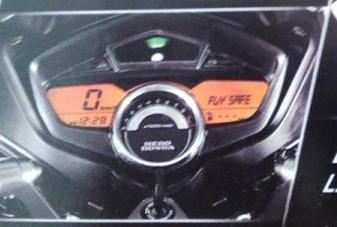
The Intrument cluster is best looking part in Karizma ZMR. Insert the key and you are greeted with a long scrolling message which ends with "Bon Voyage Fly Safe". The display is now full digital including the tachometer which has been designed in round shape under a horizontal digital display which looks very cool especially at night.
The display also shows real time fuel consumption which is very helpful in maintaining good mileage. Other tell n tales include the speedometer, trip meter, fuel indicator, clock and rev counter. The switchgear remains the same and, in true Hero Honda fashion, there is no engine kill switch. The instrument cluster features dual colour illumination - the tachometer is lit in white while the rest gets an orange backlight.
10 New Design Features Of Hero Honda Karizma ZMR:
1. Full Front Fairing
2. Split Clip On Handle Bars
3. Split Rear Grab Rails
4. Mirrors Mounted On The Fairing
5. New Rear Mud Guard
6. New Headlamp & Tail Lamp Which Is Now LED
7. Rear Disc Brakes
8. Turn Indicators Mounted On Front Fairing
9. New Graphics
10. Slightly Reprofiled Body Work
Engine & Top Speed Of Hero Honda Karizma ZMR
New Karizma ZMR Fi is powered by the same 223cc engine but has been altered by Hero Honda engineers, now it gets fuel injection which has increased the maximum power to 17.6 Bhp at 7000 rpm which is up by 0.6 Bhp and maximum torque has been increased by .15 Nm which is now 18.35 Nm @ 6000 rpm.
Hero Honda has claimed top speed of 126 kmph and 0-60 km in 3.7 seconds in its official brochure but it is still slower than the current fastest bike in this segment - The Pulsar 220, which has top speed of 144 kmph. Also I expected much more power and torque from the altered Fuel Injected engine, Karizma ZMR should have been atleast touching around 20 Bhp with 21-23 Nm torque.
Comparison Of New Karizma ZMR, Pulsar 220, Yamaha R15 & Apache RTR 180
| Data | New Karizma ZMR | Bajaj Pulsar 220 | Yamaha R15 | Apache 180 |
| Engine | 4 Stroke | 4 Stroke | 4 Stroke | 4 Stroke |
| Displacement | 223cc | 220cc | 149.8cc | 177.4cc |
| Max Power | 17.6 Bhp-7000 rpm | 21 Bhp-8500 rpm | 17 Bhp-8500 rpm | 17.3 Bhp-8500 rpm |
| Max Torque | 18.5 Nm-6000 rpm | 19 Nm-7000 rpm | 15 Nm-7500 rpm | 15.5 Nm-6500 rpm |
| Gears | 5 Speed | 5 Speed | 6 Speed | 5 Speed |
| Cooling Type | Liquid Cooled | Air Cooled | Liquid Cooled | Air Cooled |
| Top Speed | 126 kmph | 144 kmph | 135 kmph | 125 kmph |
| 0-60 kmph | 3.70 secs | NA | 3.20 secs | 4.35 secs |
| Brakes | Discs | Discs | Discs | Discs |
| Price | 91000.00 | 71000.00 | 97000.00 | 64000.00 |
The PGM-Fi system is equipped with a 12 hole fuel injector, 16 bit ECU and 6 high-tech sensors to scan the engine operating parameters like air pressure, air temperature, and engine temperature to ensure the optimum air / fuel ratio under dynamic conditions. An advanced vertical oil cooler provides efficient cooling to the high performance engine and the IACV (Idle air control valve) ensures idle stability and smoothens response to throttle changes.
13 New Technical Features In Hero Honda Karizma ZMR:
1. PGM-Fi: Programmable Fuel Injection
2. 16 Bit ECU Processor For Rapid Digital Fuel Injection Mapping
3. Oil Cooled Engine
4. 12 Hole Fuel Injector For Better Atomization Of Fuel
5. Engine Oil Temperature Sensor Which Provides Different Fuel Mixtures At Different Temperatures
6. Intake Air Temperature Sensor Which Senses The Intake Air Temp To Determine & Supply The Optimum Air To Fuel Ratio
7. Throttle Position Sensor Which Detects Throttle Opening & Provides Input To The ECU
8. Crank Position Sensor Which Senses The Position & Time At Which Fuel Needs To Be Injected In Relation To Crank Angle
9. Oxygen Sensor Ensures Correct Air Fuel Ratio For The Catalytic Convertor
10. Manifold Absolute Pressure Sensor
11. Idle Air Control Valve
12. Gas Charged Shock Absorbers
13. Rear Disc Brake
Price & Shades Available In Hero Honda Karizma ZMR
New Hero Honda Karizma ZMR has been priced at Rs. 91,000 (Ex-Showroom New Delhi). The price is on the higher side in comparison to Bajaj Pulsar 220 which comes almost 20,000 cheaper and is more powerful in comparison to Karizma Fi. But Karizma is Liquid Cooled and technically more advanced in comparison to Pulsar 220. Also Karizma ZMR is a quality product, there is no compromise in quality of materials and paint quality.
Ex-Showroom Price Of Hero Honda Karizma ZMR in Other Cities:
Mumbai - 95300.00
Bangalore, Chandigarh, Chennai, Cochin - 91000.00
Faridabad, Gurgaon, Hyderabad, Kolkata - 91,000.00
Ghaziabad, Kanpur, Lucknow - 92696.00
Jaipur - 93100.00
Nagpur - 91880.00
Pune - 92759.00
Hero Honda Karizma ZMR Is Available In Following Five Shades:
- Pearl White
- Moon Yellow
- Panther Black
- Sports Red
- Vibrant Blue
New Karizma ZMR looks best in White Shade which gives it a bigger and meaner look. In other shades it looks a bit plasticky and down grade. Hero Honda dealers have started taking bookings of New Karizma, I visited a autorised dealer, they said that you can choose a shade and book your bike but the deliveries will start in first week of November.
Conclusion - Little Bit Overpriced In Comparison To Power & Torque Figures
Hero Honda's New Karizma ZMR Fi comes packed with more power, more style and more aggression but the new model leaves us expecting for more!! Hero Honda should a lesson or two from Yamaha which had gone almost instinct in India in 2005 but with the launch R15, FZ-Series & Fazer they are back with a bang and grabbing the premium bike market share day by day. I may not have been biased towards Yamaha if Hero Honda had come up with a more powerful and better designed version of Karizma.
Though Karizma has always been very popular among bike enthusiasts as it is a highly capable bike and it was expected that Karizma Fi will going to take it a step further. Let's see how Karizma fans react to the price, design change and will it set the sales charts on fire and will beat Pulsar, R15 & Apache.
News and Images source : http://autos.maxabout.com
Bajaj launches Kawasaki Ninja
 MUMBAI: Bajaj Auto on Wednesday announced the launch of the much awaited Kawasaki Ninja 250R in India. It is widely acknowledged as the best 250cc motorcycle in the world. In India, it will be available exclusively through Bajaj Probiking showrooms.Largest selling bike
Powered by a 249cc parallel twin engine that belts out 33PS of power, it is a true supersport motorcycle that draws its lineage from the legendary larger Kawasaki Ninjas. But what makes this motorcycle unique is its near-perfect combination of performance, riding comfort and ease of handling. As a result, it is as popular among casual riders as among serious enthusiasts. Not surprisingly, it is the largest selling 250cc motorcycle in the world.
Commenting on the launch, Eric Vas, President (New Projects) Bajaj Auto, said “We conceived Bajaj Probiking four years back with the objective of making it the automatic destination for bike enthusiasts looking for ‘bigger and sportier’ bikes. After the Bajaj Avenger DTS-i and the flagship Pulsar 220 DTS-i, the launch of the Kawasaki Ninja 250R is one of many initiatives lined up in realising that objective.”
PTI reports from Delhi:
The four-stroke bike is priced at Rs. 2.70 lakh (ex-showroom, Delhi)
Ninja 250R will be assembled at the company’s Chakan plant. The company is aiming to sell about 1,000 units in the first 12 months of the launch.
The company is present in the 135cc segment with Discover and has its Pulsar range of bikes in 150cc, 180cc and 220cc segments. In June, it unveiled an ‘affordable’ version of the 220cc Pulsar without fuel injection technology.
Pictures and news source : http://www.thehindu.com
Monday, October 5, 2009
Harley-Davidson to sell bikes in India in 2010

New Delhi: US motorcycle maker Harley-Davidson Inc on Thursday announced its plans to foray into India's motorcycle market.
Indian motorcycle market is the second largest in the world and the company is looking for establishing dealership network in the country.
“As India continues to extend its global reach, so is Harley-Davidson. We believe the company has outstanding opportunities for continued growth around the world,” Harley-Davidson Motor Company (HDMC) president and Chief Operating Officer Matthew Levatich said in a statement.
With a plan to start selling its iconic motorcycles in India by next year, the company has established a subsidiary in Gurgaon.
This subsidy will be led by Managing Director Anoop Prakash.
Anoop said the company has begun the process of identifying initial dealers in Mumbai, Delhi, Bangalore, Hyderabad and Punjab.
The company will currently import its motorcycles, accessories and riding gear, and will evaluate how best to evolve its approach to the market as its business in India grows.
Indian motorcycle market is dominated by small, inexpensive bikes which are used for basic transportation.
However, the country's rapidly growing economy, rising middle class and significant investment in construction of new highways have opened the door to leisure motorcycle riding.
“Given the rapid development of India's economy and physical infrastructure, this is exactly the right time to bring the world's greatest motorcycles to one of the world's largest motorcycling nations,” Levatich said.
Harley-Davidson is the global leader in cruising and touring motorcycles and ranks as one of the strongest brands in the world.
Its motorcycles are sold in more than 70 countries now.
Harley-Davidson Inc is the parent company for the group of companies doing business as HDMC, Buell Motorcycle Company (Buell), MV Agusta and Harley-Davidson Financial Services (HDFS).
While, HDMC produces heavyweight custom, touring and cruiser motorcycles, Buell makes American sport performance motorcycles and MV Agusta manufactures premium, high-performance sport motorcycles sold under the MV Agusta brand and lightweight sport motorcycles sold under the Cagiva brand.
HDFS provides wholesale and retail financing and insurance programs primarily to Harley-Davidson and Buell dealers and customers.
Indian motorcycle market is the second largest in the world and the company is looking for establishing dealership network in the country.
“As India continues to extend its global reach, so is Harley-Davidson. We believe the company has outstanding opportunities for continued growth around the world,” Harley-Davidson Motor Company (HDMC) president and Chief Operating Officer Matthew Levatich said in a statement.
With a plan to start selling its iconic motorcycles in India by next year, the company has established a subsidiary in Gurgaon.
This subsidy will be led by Managing Director Anoop Prakash.
Anoop said the company has begun the process of identifying initial dealers in Mumbai, Delhi, Bangalore, Hyderabad and Punjab.
The company will currently import its motorcycles, accessories and riding gear, and will evaluate how best to evolve its approach to the market as its business in India grows.
Indian motorcycle market is dominated by small, inexpensive bikes which are used for basic transportation.
However, the country's rapidly growing economy, rising middle class and significant investment in construction of new highways have opened the door to leisure motorcycle riding.
“Given the rapid development of India's economy and physical infrastructure, this is exactly the right time to bring the world's greatest motorcycles to one of the world's largest motorcycling nations,” Levatich said.
Harley-Davidson is the global leader in cruising and touring motorcycles and ranks as one of the strongest brands in the world.
Its motorcycles are sold in more than 70 countries now.
Harley-Davidson Inc is the parent company for the group of companies doing business as HDMC, Buell Motorcycle Company (Buell), MV Agusta and Harley-Davidson Financial Services (HDFS).
While, HDMC produces heavyweight custom, touring and cruiser motorcycles, Buell makes American sport performance motorcycles and MV Agusta manufactures premium, high-performance sport motorcycles sold under the MV Agusta brand and lightweight sport motorcycles sold under the Cagiva brand.
HDFS provides wholesale and retail financing and insurance programs primarily to Harley-Davidson and Buell dealers and customers.
Source: ibnlive.com
Yamaha launches superbike for Rs 20 lakh


New Delhi: Two-wheeler manufacturer Yamaha India on Wednesday rolled out a super bike, V Max, priced at Rs 20 lakh.
The company also launched a limited edition of the Fazer and SZ Series models ahead of the upcoming festive season.
"We are expecting almost three times the sales in the two months of the festive season (starting October)," said Yamaha Chief Executive and Managing Director Yuki Mine Tsuji.
"We are targeting selling 2.5 lakh units in India by this year," Tsuji told reporters.
The company is also aiming at garnering a 10 per cent market share by 2012.
The company also launched a limited edition of the Fazer and SZ Series models ahead of the upcoming festive season.
"We are expecting almost three times the sales in the two months of the festive season (starting October)," said Yamaha Chief Executive and Managing Director Yuki Mine Tsuji.
"We are targeting selling 2.5 lakh units in India by this year," Tsuji told reporters.
The company is also aiming at garnering a 10 per cent market share by 2012.
Source: ibnlive.com
Thursday, October 1, 2009
The Bullet 500 Electra EFI Technical Specifications
The Bullet 500 Electra EFI is right now an import only model and will soon make its appearence on foreign shores soon.%5Boriginal%5D.JPG)
%5Boriginal%5D.JPG)
Apart from Fuel Injection, The Bullet 500 Electra EFI also features a Unit Construction Engine (Engine-Gearbox in a single block) and a more conventional left side gear shifter.. which sets this particular model apart from previous Royal Enfield models.
%5Boriginal%5D.JPG)
%5Boriginal%5D.JPG)
The Bullet 500 Electra EFI is right now an export only model.. The classic looking speedometer shows the reading in MPH (miles per hour). The Bullet 500 Electra also "Probably" features a twin spark plug like design on its single cylinder engine..The 500 Electra EFI also features front discs and a gas filled rear suspension.There are news of a 350 cc engine with similar Unit Construction Engine (without the Fuel Injection) that is being prepared for an India launch..!!%5Boriginal%5D.JPG)
Technical Specifications of the Royal Enfield Bullet 500 Electra EFI:
Engine:
4 Stroke Single Cylinder
Capacity: 499 cc
Max Power: 30 hp
Electronic fuel injection
Kick and Electric start
5 Gears
Suspension:
Front: Telescopic front Forks
Rear: Gas Filled, 5 stage Adjustable
Brakes:
Front: 280 mm disk with dual-piston caliper
Rear: 153 mm drum
Wheels:
Front: 90/90 X 19’
Rear: 100/90 X 19’
Capacity, weights and dimensions:
Fuel Tank of 14.5 lts (reserve 1.5 lts)
Weight 180 kg in running order
Length of 2200 cm
Width of 790 mm
Seat height of 820 mm
Fuel Consumption: 3.3 lts/100km
Source: MotoMag.Com
Suzuki Hayabusa 1300 History,Features,Specifications (Full Guide)
 The Suzuki Hayabusa (also known as the GSX1300R in some countries) is a hyper sport motorcycle originally introduced by Suzuki in 1999. It has a 1,298 cc (79.2 cu in) inline-4 engine and was consistently tested as the fastest production motorcycle in the world before the 2001 detuning agreement. The 2009 model has a MSRP of US$ 13,199.
The name Hayabusa translates directly from the Japanese as Peregrine Falcone, The bird is said to be capable of speeds of over 200 mph (320 km/h) — and predator of (perhaps not coincidentally) the common backbird.When introduced in 1999, it overtook the HondaCBR1100XX Super Blackbird as the fastest production motorcycle. The first generation of the Hayabusa was called the GSX1300R and was powered by a 1,299 cc (79.3 cu in) inline-4 liquid-cooled engine. It remained substantially unchanged up through the 2007 model year.
 Ultimate Sport, In Timeless Styling
Unique, timeless styling sculpted for wind-cheating aerodynamics. Long-distance comfort with effortless acceleration and sporty handling. A full 1340cm3 of broad, muscular torque. The Hayabusa 1300. A two-wheeled legend in a class of its own, defining balanced performance, defining Ultimate Sport.
 Hayabusa 1300 Features
1. 1340cm3 in-line 4-cylinder fuel-injected liquid-cooled DOHC engine built to deliver a broad wave of torque for effortless acceleration while reducing emissions.
2. Hard, smooth chrome-nitride Physical Vapor Deposition (PVD) coating on the upper compression and oil control piston rings reduces friction while improving cylinder sealing.
3. Suzuki Composite Electrochemical Material (SCEM) cylinder plating improves heat transfer, durability and ring seal.
4. U-shaped cutouts in the cylinder-bore sides allow air below descending pistons to escape to adjacent cylinders to reduce internal pumping pressure and mechanical power losses.
5. Lightweight titanium valves allow use of lighter valve springs and higher lift while maintaining accurate valve control. Iridium spark plugs produce more complete combustion.
6. Curved radiator with a compact, dense-core design and engine-management-computer-controlled two ring-type electric fans mounted on the rear of the radiator, increasing the control accuracy and keeping engine temperature stable.
7. Suzuki Clutch Assist System (SCAS) serves as back-torque-limiting system for smoother downshifts and also contributes to a lighter clutch pull.
8. Optimized 6-speed transmission; oil spray to the 4th, 5th and 6th gears reduce wear and mechanical noise during highway cruising.
9. Suzuki Dual Throttle Valve (SDTV) fuel injection results in improved power delivery, a more linear response, better mileage and less emissions. This system uses engine-computer-operated secondary valves to maintain optimum intake-air velocity for maximum combustion efficiency.
10. Two 12-hole fine-spray injectors on each throttle body improve fuel atomization for better combustion efficiency and while reducing fuel consumption.
11. Idle Speed Control (ISC) system improves cold starting and helps maintain stable engine idle under various conditions.
12. Suzuki Pulsed-secondary AIR-injection (PAIR) system ignites unburned hydrocarbons and reduces carbon monoxide emissions.
13. Large-volume catalyzer further reduces hydrocarbon, carbon-monoxide and nitrogen oxide emissions to help meet tough Euro 3 and TIER 2 emissions regulations standards.
14. Dual large-volume triangulated and tapered mufflers, shaped for increased banking angle and cornering clearance, enhance power and reduce noise.
15. Suzuki Drive Mode Selector (S-DMS) enables the rider to choose from three different engine power characteristics according to personal tastes and riding conditions. It offers enjoyment of top performance in a wide range of riding situations.
16. Advanced, wind-tunnel-refined aerodynamics offering superb wind protection both for normal and completely tucked-in seating positions.
17. Twin-spar aluminum-alloy frame built with castings and extrusions. The torsional rigidity of the aluminum-alloy rectangular-cross-section swingarm is increased by 10 percents.
18. Rear subframe made of rectangular steel tubing for increased weight carrying capacity.
19. Inverted cartridge front forks featuring Diamond-Like Coating (DLC) surface treatment to reduce stiction and improve reaction to small surface irregularities.
20. The front forks and the single rear shock absorber both have fully adjustable spring preload, compression and rebound damping.
21. 3-spoke cast-aluminum-alloy wheels shod with 120/70ZR17M/C (58W) front and 190/50ZR17M/C (73W) rear radial tires.
22. 310mm (12.2-inch) dual-floating-disc front brakes with efficient, race-proven aluminum-piston, radial-mount brake calipers, and 260mm (10.2-inch) single-disc rear brake with single-piston brake caliper.
23. Quality detail finishes - passenger footpeg brackets, muffler hangers, footpeg/control brackets - evoking the fine art of feudal Japanese armor, Yoroi-Kabuto.
24. Standard-equipment steering damper.
25. Integrated front turn signals form the outer edges of the ram-air-intake scoop.
26.Vertically stacked headlight featuring a projector high beam and a halogen-bulb multi-reflector low beam.
27.Unique tailsection featuring streamlined bulges carrying integrated rear turn signals and shaped with jet-engine motif.
28. Bright, durable LED taillight, with clear inner lens and red outer lens.
29. Four analog gauges including step-motor-driven tachometer and speedometer. Round LCD panel includes clock, gear position indicator, S-DMS map indicator, odometer and dual trip meters. Engine-rpm indicator, programmable to blink or stay on between 4,000 and 11,500 rpm.
30. Silver metallic trim around the analog gauges and LCD panel evoking American GT muscle-car image.

Hayabusa 1300 SpecificationsEngine Type
4-stroke, 4-cylinder, liquid-cooled, DOHC
Bore x Stroke
81.0 mm x 65.0 mm
Engine Displacement
1340 cm3 (cc)
Compression Ratio
12.5 : 1
Carburetion
Fuel injection
Oil capacity (overhaul)
4.0L (1.6 US gal.)
Ignition
Fully transistorized
Starter System
Electric
Lubrication System
Wet sump
Transmission
6-speed constant mesh
Primary Drive Ratio
1.596 (83 / 52)
Final Drive Ratio
2.388 (43 / 18)
Frame Type
Twin-spar (aluminum-alloy)
Rake / Trail
24.2 degrees / 98 mm (3.9 in.)
Suspension
Front
Inverted telescopic, coil spring, spring preload fully adjustable, rebound and compression damping force fully adjustable
Rear
Link type, coil spring, oil damped, spring preload fully adjustable, rebound and compression damping force fully adjustable
Wheels
Front
17 M/C x MT3.50, cast aluminum alloy
Rear
17 M/C x MT6.00, cast aluminum alloy
Brakes
Front
Radial mount, 4-piston calipers, 310 mm disc, twin
Rear
1-piston caliper, 260 mm disc
Tyres
Front
120/70ZR17M/C (58W), tubeless
Rear
190/50ZR17M/C (73W), tubeless
Fuel Tank Capacity
21.0 L (5.5 US gal.)
Overall Length
2,195 mm (86.6 in.)
Overall Width
740 mm (29.1 in.)
Overall Height
1,170 mm (46.1 in.)
Wheelbase
1,485 mm (58.5 in.)
Seat Height
805 mm (31.7 in.)
Dry Weight
220kg (485 lbs.)

Source: http://www.globalsuzuki.com/ & wikipedia.org
 Ultimate Sport, In Timeless Styling
Unique, timeless styling sculpted for wind-cheating aerodynamics. Long-distance comfort with effortless acceleration and sporty handling. A full 1340cm3 of broad, muscular torque. The Hayabusa 1300. A two-wheeled legend in a class of its own, defining balanced performance, defining Ultimate Sport.
Hayabusa 1300 Features1. 1340cm3 in-line 4-cylinder fuel-injected liquid-cooled DOHC engine built to deliver a broad wave of torque for effortless acceleration while reducing emissions.
2. Hard, smooth chrome-nitride Physical Vapor Deposition (PVD) coating on the upper compression and oil control piston rings reduces friction while improving cylinder sealing.
3. Suzuki Composite Electrochemical Material (SCEM) cylinder plating improves heat transfer, durability and ring seal.
4. U-shaped cutouts in the cylinder-bore sides allow air below descending pistons to escape to adjacent cylinders to reduce internal pumping pressure and mechanical power losses.
5. Lightweight titanium valves allow use of lighter valve springs and higher lift while maintaining accurate valve control. Iridium spark plugs produce more complete combustion.
6. Curved radiator with a compact, dense-core design and engine-management-computer-controlled two ring-type electric fans mounted on the rear of the radiator, increasing the control accuracy and keeping engine temperature stable.
7. Suzuki Clutch Assist System (SCAS) serves as back-torque-limiting system for smoother downshifts and also contributes to a lighter clutch pull.
8. Optimized 6-speed transmission; oil spray to the 4th, 5th and 6th gears reduce wear and mechanical noise during highway cruising.
9. Suzuki Dual Throttle Valve (SDTV) fuel injection results in improved power delivery, a more linear response, better mileage and less emissions. This system uses engine-computer-operated secondary valves to maintain optimum intake-air velocity for maximum combustion efficiency.
10. Two 12-hole fine-spray injectors on each throttle body improve fuel atomization for better combustion efficiency and while reducing fuel consumption.
11. Idle Speed Control (ISC) system improves cold starting and helps maintain stable engine idle under various conditions.
12. Suzuki Pulsed-secondary AIR-injection (PAIR) system ignites unburned hydrocarbons and reduces carbon monoxide emissions.
13. Large-volume catalyzer further reduces hydrocarbon, carbon-monoxide and nitrogen oxide emissions to help meet tough Euro 3 and TIER 2 emissions regulations standards.
14. Dual large-volume triangulated and tapered mufflers, shaped for increased banking angle and cornering clearance, enhance power and reduce noise.
15. Suzuki Drive Mode Selector (S-DMS) enables the rider to choose from three different engine power characteristics according to personal tastes and riding conditions. It offers enjoyment of top performance in a wide range of riding situations.
16. Advanced, wind-tunnel-refined aerodynamics offering superb wind protection both for normal and completely tucked-in seating positions.
17. Twin-spar aluminum-alloy frame built with castings and extrusions. The torsional rigidity of the aluminum-alloy rectangular-cross-section swingarm is increased by 10 percents.
18. Rear subframe made of rectangular steel tubing for increased weight carrying capacity.
19. Inverted cartridge front forks featuring Diamond-Like Coating (DLC) surface treatment to reduce stiction and improve reaction to small surface irregularities.
20. The front forks and the single rear shock absorber both have fully adjustable spring preload, compression and rebound damping.
21. 3-spoke cast-aluminum-alloy wheels shod with 120/70ZR17M/C (58W) front and 190/50ZR17M/C (73W) rear radial tires.
22. 310mm (12.2-inch) dual-floating-disc front brakes with efficient, race-proven aluminum-piston, radial-mount brake calipers, and 260mm (10.2-inch) single-disc rear brake with single-piston brake caliper.
23. Quality detail finishes - passenger footpeg brackets, muffler hangers, footpeg/control brackets - evoking the fine art of feudal Japanese armor, Yoroi-Kabuto.
24. Standard-equipment steering damper.
25. Integrated front turn signals form the outer edges of the ram-air-intake scoop.
26.Vertically stacked headlight featuring a projector high beam and a halogen-bulb multi-reflector low beam.
27.Unique tailsection featuring streamlined bulges carrying integrated rear turn signals and shaped with jet-engine motif.
28. Bright, durable LED taillight, with clear inner lens and red outer lens.
29. Four analog gauges including step-motor-driven tachometer and speedometer. Round LCD panel includes clock, gear position indicator, S-DMS map indicator, odometer and dual trip meters. Engine-rpm indicator, programmable to blink or stay on between 4,000 and 11,500 rpm.
30. Silver metallic trim around the analog gauges and LCD panel evoking American GT muscle-car image.

Hayabusa 1300 SpecificationsEngine Type
4-stroke, 4-cylinder, liquid-cooled, DOHC
Bore x Stroke
81.0 mm x 65.0 mm
Engine Displacement
1340 cm3 (cc)
Compression Ratio
12.5 : 1
Carburetion
Fuel injection
Oil capacity (overhaul)
4.0L (1.6 US gal.)
Ignition
Fully transistorized
Starter System
Electric
Lubrication System
Wet sump
Transmission
6-speed constant mesh
Primary Drive Ratio
1.596 (83 / 52)
Final Drive Ratio
2.388 (43 / 18)
Frame Type
Twin-spar (aluminum-alloy)
Rake / Trail
24.2 degrees / 98 mm (3.9 in.)
Suspension
Front
Inverted telescopic, coil spring, spring preload fully adjustable, rebound and compression damping force fully adjustable
Rear
Link type, coil spring, oil damped, spring preload fully adjustable, rebound and compression damping force fully adjustable
Wheels
Front
17 M/C x MT3.50, cast aluminum alloy
Rear
17 M/C x MT6.00, cast aluminum alloy
Brakes
Front
Radial mount, 4-piston calipers, 310 mm disc, twin
Rear
1-piston caliper, 260 mm disc
Tyres
Front
120/70ZR17M/C (58W), tubeless
Rear
190/50ZR17M/C (73W), tubeless
Fuel Tank Capacity
21.0 L (5.5 US gal.)
Overall Length
2,195 mm (86.6 in.)
Overall Width
740 mm (29.1 in.)
Overall Height
1,170 mm (46.1 in.)
Wheelbase
1,485 mm (58.5 in.)
Seat Height
805 mm (31.7 in.)
Dry Weight
220kg (485 lbs.)

Source: http://www.globalsuzuki.com/ & wikipedia.org
Wednesday, September 30, 2009
New Bajaj Pulsar 220
 Bajaj new Pulsar 220 DTS-I 2009 FeaturesTwo-wheeler Giant Bajaj Auto is set to launch Bajaj new Pulsar 220 DTS-I 2009 bike in Indian roads in July, 2009. The changes in the pulsar 220 DTS-i will be cosmetic. Bajaj’s new pulsar 220cc DTS-FI will embrace the contemporary all black theme adn get new body graphics. New Pulsar 220cc DTS-FI will also get carbon fibre exhaust which will surely improve the masculinity of the pulsar but also unique exhaust beat. The weight of this bike is around 136 kg. The Bajaj Pulsar DTS-Fi is expected to touch a top speed of 144kph. The most important feature of all is the fuel injection mechanism, which is responsible for the quick throttle and the linear power curve.The Pulsar 220 DTS-i uses a sweet-shifting five-speed, one-down-and-four-up gearbox complemented by a well-weighted clutch. This bike is available in variety of colors like Black, Blue, Grey & Red. It is coming with tubeless tires. Bajaj Pulsar new bike is here DTS-I, is an acronym for Digital Twin Spark-Fuel injected, implies the marriage of twin spark plugs and fuel-injection within its four-stroke cycle engine. Running two valves, the Pulsar DTS-Fi engine is air-cooled and circulates oil to an oil-cooler to further control temperature. This bike is amongst India’s most powerful with a healthy 20bhp developed at 8500rpm. Maximum torque of 1.95kgm twists out at 6500rpm.
Bajaj-KTM alliance launces Super bikes

Bajaj Auto and KTM Power Sports AG's two and a half year old coalition will result in the yielding of some intricate, high-end super bikes sometime around next year. Apart from selling KTM branded bikes in India, the second largest auto major of the country now has plans to collectively manufacture bikes for the benefit of both the companies and for this, it will be spending about Rs.140 crore this financial year in its R&D department.Till date, Bajaj has only 1 bike with an engine capacity of 220cc but it will soon be expanding with the launch of KTM's Duke 690, a 654 cc, four stroke engine bike and 1190 RC8 Superbike, a1148 cc bike in India by next year. Also in the pipeline is a joint venture by mid 2010 and Bajaj's 1st super bike with some help from KTM in 2011. This alliance has certainly benefited Bajaj. Mr. Rajiv Bajaj, MD, Bajaj Auto is on board of KTM with 31.72% stakes.
Source: http://www.bikeindia.in/
Honda's new 300cc bikes
 Honda replaced the CBX 250 Twister in the Brazlian market with a 300cc bike named the CB300R. The bike looks like a scaled down Hornet and definitely one of the better looking small capacity bikes out there. The bike adorns a 110mm dia tyre up front and a fat 140mm at the rear. Powered by an air cooled 292cc engine that produces around 26.5 bhp, the 300R seems to be the perfect answer to our cries for a sporty naked machine with enough power to satisfy most users. The engine also gets Honda’s famed PGM-FI technology.
Bajaj discontinues Pulsar 200cc
 The recent launch of the 'cheaper' carbureted variant of the Pulsar 220 has sent shock waves in the premium biking segment. Some of us even pondered over existence of the smaller Pulsar 200 now. The new 2009 Pulsar 220 with more power and goodies sells for just a little more than the 200 - wouldn't that effect the sales of the younger sibling was our question. The answer however has come our way quickly. Bajaj has officially pulled off the Pulsar 200 from the manufacturing lines citing that it made no sense for them to sell it anymore when buyers were getting lured by the improved and rocking value for money Pulsar 220. The company sold 48,062 units of the complete Pulsar range in June 2009 and is looking forward to improve this number for July 2009.
Tuesday, September 29, 2009
Harley Davidson: The Big Boys Come To India


Tomorrow is a new dawn. A new chapter in the 107 year history of the company and the birth of the genuine Harley-Davidson experience in India. A billion dreams find voice in this glorious land, as India fulfills its destiny as a 21st century powerhouse. At the heart of Harley-Davidson is the promise to inspire and fulfill dreams, to free the spirit. Our paths were destined to cross…
With these words, the best known cruiser company of the world, Harley Davidson makes it foray into the Indian subcontinent to entice us to chase our unfulfilled, unseen, unrealized dreams with its world class superior tech laden monstrous range of cruiser bikes. This comes at a time when Indian market has been a hot favorite among all the foreign brands. With the launch of big bikes from Suzuki, Kawasaki, Honda and Yamaha, market has been seen quite ripe for 10 lakh plus bikes in India. Although these bikes target a very minuscule yet very lucrative segment of the crowd, these advancements certainly heralds the way we are heading to.
Harley Davidson has been mulling over its foray into the Indian subcontinent for quite sometime now but due to some legal issues and stringent pollution norms they were not able to make it to India. But seems like things have finally settled down and we can experience the true Cruiser magic to be unleashed on the Indian roads pretty soon. The official launch has taken place and the bikes are expected to hit the roads by mid 2010. Harley plans to introduce the following bikes to India
SPORTSTER : Loaded with an 883 cc air cooled engine, these bikes would be the smallest capacity entry level Harleys for India
DYNA: Sporting a massive 1.6 litre engine, these bikes have a true classic appeal attached to them.
V-ROD: Probably would be the costliest Harleys and the sexiest ones as well.
CVO : Might be the slowest entrants to the scene
The company has set up its subsidiary at Gurgaon and has started inviting applications from dealers. As of now all the bikes would come as CBUs (Completely Built Units) and later on we might see the assembling part being done here, in turn reducing the price tags of these bikes. The company, which sells motorcycles in more than 70 countries, has planned to strengthen its brand first through various customer experiences and feedback.
All the bikes would come upwards of 12 lakh INR and would ensure that you get the best of the fascinated American experience. For this sake, Harley is building a well knit chain of dealers in Mumbai, Delhi, Hyderabad and Punjab initially and later on spread to other potential cities along with service stations choosing the very best and technically qualified people from the industry.
To add to the true Big American Cruiser experience, Harleys would provide custom made tattoos and company authenticated riding gear as well which would enhance the raw looks of the bike and the biker and instill the true cruiser feeling. So what is the wait for, Big Boys are finally here! For more information read Harley Davidson India Official Website
With these words, the best known cruiser company of the world, Harley Davidson makes it foray into the Indian subcontinent to entice us to chase our unfulfilled, unseen, unrealized dreams with its world class superior tech laden monstrous range of cruiser bikes. This comes at a time when Indian market has been a hot favorite among all the foreign brands. With the launch of big bikes from Suzuki, Kawasaki, Honda and Yamaha, market has been seen quite ripe for 10 lakh plus bikes in India. Although these bikes target a very minuscule yet very lucrative segment of the crowd, these advancements certainly heralds the way we are heading to.
Harley Davidson has been mulling over its foray into the Indian subcontinent for quite sometime now but due to some legal issues and stringent pollution norms they were not able to make it to India. But seems like things have finally settled down and we can experience the true Cruiser magic to be unleashed on the Indian roads pretty soon. The official launch has taken place and the bikes are expected to hit the roads by mid 2010. Harley plans to introduce the following bikes to India
SPORTSTER : Loaded with an 883 cc air cooled engine, these bikes would be the smallest capacity entry level Harleys for India
DYNA: Sporting a massive 1.6 litre engine, these bikes have a true classic appeal attached to them.
V-ROD: Probably would be the costliest Harleys and the sexiest ones as well.
CVO : Might be the slowest entrants to the scene
The company has set up its subsidiary at Gurgaon and has started inviting applications from dealers. As of now all the bikes would come as CBUs (Completely Built Units) and later on we might see the assembling part being done here, in turn reducing the price tags of these bikes. The company, which sells motorcycles in more than 70 countries, has planned to strengthen its brand first through various customer experiences and feedback.
All the bikes would come upwards of 12 lakh INR and would ensure that you get the best of the fascinated American experience. For this sake, Harley is building a well knit chain of dealers in Mumbai, Delhi, Hyderabad and Punjab initially and later on spread to other potential cities along with service stations choosing the very best and technically qualified people from the industry.
To add to the true Big American Cruiser experience, Harleys would provide custom made tattoos and company authenticated riding gear as well which would enhance the raw looks of the bike and the biker and instill the true cruiser feeling. So what is the wait for, Big Boys are finally here! For more information read Harley Davidson India Official Website

TVS Apache RTR 180 – Project Menace
 TVS Motors has recently rolled out a bigger brother of its award winning Apache series, yes the RTR 180! The much waited and anticipated APACHE RTR 180 which was being developed under the project code known as Menace was launched recently creating a big revolution in the world of racing.
The bike is just stunning with it’s refreshing new looks the engine and not to mention the new ergonomics, the bike takes it all with pride.
Yamaha YZF-R1 LE
Yamaha has unveiled it’s 2010 model “one”. Yes, the much awaited 2010 YZF R1 has been revealed by Yamaha that has taken a clean sweep of all the racing hearts around the world. The reason? It’s pretty simple with the technology that is offered in MotoGP is now on R1.
The “One” Engine
The Cross plane crank shaft: This is the “one” that separates men from the boys. This technology was first pioneered in MotoGP racing with the YZR M1. The technology behind this is that it puts each piston at 90 degree from the next with an uneven firing interval of 270-180-90-180 degrees respectively.
Crazy stuff isn’t it? Does it matter in street bikes? Yes, because Yamaha wants the world to know what kept them winning in MOTOGP and now they wanted to implement them in street bikes preferably in YZF R1. I know there are questions arising like, are there any advantages? And the answer is yes, the advantages of these are pretty huge, as it lets the power to build up smoothly which provides better and smooth roll-on’s out of the corners with a firm plant of the bike on ground. The engine also features forged aluminum pistons that take maximum advantage of the power characteristics coupled along with titanium intake valves that are lightweight in construction.
Forced Air Intake: The bike is adopted with an Forced Air Intake system that helps to increase the air intake efficiently by utilizing the natural airflow while riding that pressurizes the air in the air box that contributes to an out standing power delivery in the top end range while the new design also minimizes the air intake noise.
Slipper clutch: This is quite common in all super bikes, but a slipper clutch with a back torque limiter?? Only in the “One”, the slipper clutch with a back torque limiter helps in breaking or downshifting from high rpm a risk free and a smooth one.
Dual Under seat Exhaust: The dual under seat exhaust not only enhances the look of the bike but does more than that. The exhaust is carefully designed to enhance the engine output while the three way catalyst technology will take care of the emission and sound norms and with all these norms the bike is still a screamer.
Fuel Injected: The fuel injected engine has the full advantage of Yamaha Chip Controlled Throttle YCC-T coupled with the MotoGP inspired YZR M1’s Fly-by-Wire technology that delivers instant throttle response irrespective of the engaged gear. The engine also features the Yamaha Chip Controlled Intake YCC-I a variable intake system that wideness the spread of power. The fuel injectors also have 12 nozzles for optimum fuel optimization that translates power from every fuel that burns.
Drive Mode: Yamaha offers the Yamaha D-Mode also known as Drive mode variable throttle control in which three drive modes can be selected according to the purpose that are easily accessible in the handle bars. The “A” mode is typically track mode that puts more emphasis on engine response in the low and mid range rpm. The “B” mode provides less sensitive throttle response that can be used for city riding and the last the Standard map is designed for optimum overall performance.
“One Chassis”
Yamaha the inventor of Delta Box frame, will they do any lesser for this beast? The frame is rigid and solid and is composed of controlled-fill die-cast, stamping and gravity casting that contribute a majority of the bike’s handling.
Forks: The bike features SOQI front forks (for people wondering what’s SOQI, it’s just a division owned by Yamaha that manufactures Shocks) that is exactly the same in the race winning MOTOGP YZR M1. What’s the difference it makes? The difference is that both the forks always move together which shares the duties among themselves where the compression damping duties will be taken care by the left fork while rebound damping is precisely handled by the right fork which eventually reduces oil cavitation.
Rear Shock: The mono rear shock a feature both high and low speed compression damping and also has an easy-to-use hydraulic screw adjustment for preload. The unit incorporates pillow-ball-type joint for exceptional shock absorption, road feeling and exceptional damper response. The brilliant and crisp handling characteristics are achieved by the bottom linkage that is designed to work with the rest of the chassis.
With all the features, the bike is sure to set the pulse racing. Here goes the news for the light hearted people, this bike is a limited edition “one” and only a few will be available throughout the world although there is no idea of Yamaha India bringing this bike to India but when here will surely keep the hearts and tracks on fire.

Yes, we all know that it’s already available in 2009 YZF R1, anything new? The answer will be a big yes! Because, Yamaha has finally come up with the bold and the beautiful Rossi replica theme in the 2010 YZF R1 with those stunning “Fiat Yamaha” Team graphics, “#46” and “The Doctor” decals including a bright replica of Valentino Rossi’s signature on the fuel tank. That provides the ultimate style with substance for all the Rossi fans.
The “One” Engine
The Cross plane crank shaft: This is the “one” that separates men from the boys. This technology was first pioneered in MotoGP racing with the YZR M1. The technology behind this is that it puts each piston at 90 degree from the next with an uneven firing interval of 270-180-90-180 degrees respectively.
Crazy stuff isn’t it? Does it matter in street bikes? Yes, because Yamaha wants the world to know what kept them winning in MOTOGP and now they wanted to implement them in street bikes preferably in YZF R1. I know there are questions arising like, are there any advantages? And the answer is yes, the advantages of these are pretty huge, as it lets the power to build up smoothly which provides better and smooth roll-on’s out of the corners with a firm plant of the bike on ground. The engine also features forged aluminum pistons that take maximum advantage of the power characteristics coupled along with titanium intake valves that are lightweight in construction.
Forced Air Intake: The bike is adopted with an Forced Air Intake system that helps to increase the air intake efficiently by utilizing the natural airflow while riding that pressurizes the air in the air box that contributes to an out standing power delivery in the top end range while the new design also minimizes the air intake noise.
Slipper clutch: This is quite common in all super bikes, but a slipper clutch with a back torque limiter?? Only in the “One”, the slipper clutch with a back torque limiter helps in breaking or downshifting from high rpm a risk free and a smooth one.
Dual Under seat Exhaust: The dual under seat exhaust not only enhances the look of the bike but does more than that. The exhaust is carefully designed to enhance the engine output while the three way catalyst technology will take care of the emission and sound norms and with all these norms the bike is still a screamer.
Fuel Injected: The fuel injected engine has the full advantage of Yamaha Chip Controlled Throttle YCC-T coupled with the MotoGP inspired YZR M1’s Fly-by-Wire technology that delivers instant throttle response irrespective of the engaged gear. The engine also features the Yamaha Chip Controlled Intake YCC-I a variable intake system that wideness the spread of power. The fuel injectors also have 12 nozzles for optimum fuel optimization that translates power from every fuel that burns.
Drive Mode: Yamaha offers the Yamaha D-Mode also known as Drive mode variable throttle control in which three drive modes can be selected according to the purpose that are easily accessible in the handle bars. The “A” mode is typically track mode that puts more emphasis on engine response in the low and mid range rpm. The “B” mode provides less sensitive throttle response that can be used for city riding and the last the Standard map is designed for optimum overall performance.
“One Chassis”
Yamaha the inventor of Delta Box frame, will they do any lesser for this beast? The frame is rigid and solid and is composed of controlled-fill die-cast, stamping and gravity casting that contribute a majority of the bike’s handling.
Forks: The bike features SOQI front forks (for people wondering what’s SOQI, it’s just a division owned by Yamaha that manufactures Shocks) that is exactly the same in the race winning MOTOGP YZR M1. What’s the difference it makes? The difference is that both the forks always move together which shares the duties among themselves where the compression damping duties will be taken care by the left fork while rebound damping is precisely handled by the right fork which eventually reduces oil cavitation.
Rear Shock: The mono rear shock a feature both high and low speed compression damping and also has an easy-to-use hydraulic screw adjustment for preload. The unit incorporates pillow-ball-type joint for exceptional shock absorption, road feeling and exceptional damper response. The brilliant and crisp handling characteristics are achieved by the bottom linkage that is designed to work with the rest of the chassis.
With all the features, the bike is sure to set the pulse racing. Here goes the news for the light hearted people, this bike is a limited edition “one” and only a few will be available throughout the world although there is no idea of Yamaha India bringing this bike to India but when here will surely keep the hearts and tracks on fire.
Mahindra Launches Rodeo and Duro, Two New Scooters
 Mahindra & Mahindra, the company behind the famed Scorpio and Xylo vehicles have entered the two wheeler segment with two new scooters, Rodeo and Duro. Both of these scooters fall in the 125cc category and are equipped with a host of features to make among the best machines in its class. Both sport slightly different designs and suit different personalities They have been developed with inputs from SYM, Taiwan as well as Italy’s Engines Engineering.The Rodeo is a high performance scooter with a long feature list. It sports a 125cc engine that offers 8 bhp of power, which makes among the most powerful in its class. It also features telescopic suspension systems and a 7 AH battery which is of comparatively lesser maintenance. It also features a colour changing digital console which displays information like trip meter, clock, tachometer, speed and odometer. It also has a USB port which works as a mobile charger to keep you connected on the move.
New Hero Honda Karizma Fi Launched!
Expectations have been high and the imminent launch of the new Karizma was awaited for over a couple of months now, even the folks at Yamaha like most of us thought that this bike would set the benchmark for 225cc bikes like how its predecessor did, the leaked picture of the bike undergoing testing and at the showroom surely killed the anticipation but now Hero Honda have finally officially launched the bike. This is an upgrade to the current Karizma being sold.
A lot of people have expected a lot both in terms of performance and looks from the new bike and so far it seems to be a a huge letdown. Rumors floated around that this bike would feature an all new 250cc engine, it was all just a rumor.For starters, it features the same 223cc engine from the older vehicle with the only difference being fuel injection.
A lot of people have expected a lot both in terms of performance and looks from the new bike and so far it seems to be a a huge letdown. Rumors floated around that this bike would feature an all new 250cc engine, it was all just a rumor.For starters, it features the same 223cc engine from the older vehicle with the only difference being fuel injection.

Yamaha Launches V-Max In India

Yamaha have launched the 2009 V-Max in India, this is the third bike in its stable beside the R1 and MT-01 in India and this would help Yamaha to expand its product portfolio in the country. In case you were wondering, this machine is powered by a 4 cylinder 1679cc engine that produces 200bhp with an amazing torque of 167Nm.
The Engine: A 1,679cc liquid-cooled 4-stroke DOHC 65 degree V4 engine that develops 200 PS at 9,000 rpm, together with a torque output of 166.8 Nm at 6,500 rpm, is the heart of this machine, features such as YCC-I (Yamaha Chip Controlled Intake) and YCC-T (Yamaha Chip Controlled Throttle) work together with the high capacity engine to enhance performance and drivability.
The Engine: A 1,679cc liquid-cooled 4-stroke DOHC 65 degree V4 engine that develops 200 PS at 9,000 rpm, together with a torque output of 166.8 Nm at 6,500 rpm, is the heart of this machine, features such as YCC-I (Yamaha Chip Controlled Intake) and YCC-T (Yamaha Chip Controlled Throttle) work together with the high capacity engine to enhance performance and drivability.
Monday, September 28, 2009
KAWASAKI NINJA 250R
Yes you have read it correct. If words from Bajaj officials are anything to go by, you will soon be riding one of these machines for 2 Lakhs or thereabouts. Some of you might say 2 lakhs… isnt it too much? No sir, you would be horribly wrong if you think so. With the present duty structure, this bike if imported, would cost anywhere between 3.5 - 4 lakh rupees. So how, you would ask Bajaj would manage to sell it at 2 lakhs? The answer is CKD (Completely Knocked Down kit).
For more on CKD you can go through here http://en.wikipedia.org/wiki/Complete_knock_down
In a nutshell, it means that some parts would be made locally while major components like engine and gearbox would be imported.
Bringing a product via the CKD route attracts the least duty, close 30-40 percent, but it also means that an assembly line is needed and some parts would also have to be sourced locally.
Conversly, the Yamaha R1 is being brought into India as a CBU and hence more than 100% duty and therefore a product which costs around 5 lakhs in US, costs 10.5 lakhs by the time its here.
In a first again for the 2 wheeler market in India, Bajaj will import the Ninja 250R as CKD to avoid high import duties and hence would be able to price the bike at a very competitive 2 lakh rupees. This move yet again shows the commitment Bajaj has towards the Indian 2 wheeler market and how it wants to give the customer the best possible product at most competitive prices. We just hope that other companies also follow suit.
Infact we had such an announcement from Suzuki. We will post once we have further updates on this.


For more on CKD you can go through here http://en.wikipedia.org/wiki/Complete_knock_down
In a nutshell, it means that some parts would be made locally while major components like engine and gearbox would be imported.
Bringing a product via the CKD route attracts the least duty, close 30-40 percent, but it also means that an assembly line is needed and some parts would also have to be sourced locally.
Conversly, the Yamaha R1 is being brought into India as a CBU and hence more than 100% duty and therefore a product which costs around 5 lakhs in US, costs 10.5 lakhs by the time its here.
In a first again for the 2 wheeler market in India, Bajaj will import the Ninja 250R as CKD to avoid high import duties and hence would be able to price the bike at a very competitive 2 lakh rupees. This move yet again shows the commitment Bajaj has towards the Indian 2 wheeler market and how it wants to give the customer the best possible product at most competitive prices. We just hope that other companies also follow suit.
Infact we had such an announcement from Suzuki. We will post once we have further updates on this.
Kawasaki Ninja 250R at the Delhi Auto Expo:


Subscribe to:
Posts (Atom)

